English
 日本語
日本語 한국어
한국어 français
 Deutsch
 Español
 italiano
 русский
 português
 العربية
 Nederland
Sorbitan monostearate (E491, HLB 4.7; compliant with GB 13841-2011 and GB 2760) is a classic lipophilic non-ionic emulsifier that serves as a structural stabilizer and fat crystallization modifier across a full range of food systems. It can be used on its own to stabilize water-in-oil systems, and when paired with polysorbate 60, it is highly effective in oil-in-water products such as ice cream — making it an indispensable functional ingredient in food formulations.
In actual production, sorbitan monostearate addresses the following three pain points in the ice cream industry:
Pain Point 1: Poor Shape Retention — Soft and weak extrusion from the freezer, poor overrun retention, and bending or collapse after demolding.
Pain Point 2: Inferior Mouthfeel — Ice crystal growth during prolonged storage leads to a coarse, grainy texture.
Pain Point 3: Weak Heat-Shock Resistance — Prone to melting into a soupy mess after thermal shock during cold-chain transport, with surface fat exudation and whitening.
The core value of sorbitan monostearate lies in its unique crystal modulation mechanism — it builds a microscopic structural scaffold that provides structural support for ice cream.
The following outlines its critical roles across four key stages of the production process:
1. Ingredient Blending Stage
Added after the fats are melted, sorbitan monostearate forms a composite protective film at the oil-water interface. This shields the mix during high-temperature pasteurization, prevents fat separation and creaming, and ensures a uniform, stable base mix.
2. Aging Stage at 0–4 °C (Critical Pre-Modification)
Sorbitan monostearate gradually displaces casein on the surface of fat globules, deliberately reducing excessive emulsion stability. It also induces the formation of early-stage α-type fat microcrystals on the globule surface, creating bridging sites for controlled partial coalescence during the freezing stage — thereby preventing both insufficient agglomeration and excessive fat-out.
3. Freezing & Aeration Stage
Under low-temperature shear, the fat microcrystals interlock to form a three-dimensional fat network. While sorbitan monostearate does not directly contribute to foaming, it firmly locks in the fine air cells introduced by polysorbate 60, stabilizes overrun, and ensures a firm, dry extrusion.
4. Hardening & Cold-Chain Storage
The fat network acts as a barrier against the diffusion of free water, suppressing ice crystal recrystallization and growth — resulting in a smooth, ice-grit-free mouthfeel. The stable structural scaffold maintains the product's shape, resists softening and dripping at ambient temperature, and significantly enhances melt resistance.
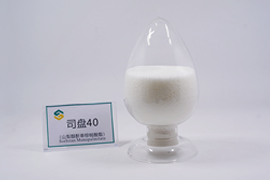
SMS, Sorbitan Monostearate Item Index / Specification | |
Molecular Formula: C24H46O6 | |
Molecular Weight: 430.61 | |
CAS NO.: | 1338-41-6 |
E NO.: | sobitan monostearate E491 |
Properties: At room temperature, it is a pale yellow granular solid. Above its melting point, it is soluble in ethanol and toluene, insoluble in cold water, dispersible in warm water, and soluble (slightly turbid) in mineral oil and ethyl acetate above 50°C. Melting point 54-56°C. It possesses emulsifying, stabilizing, and defoaming properties. It is a W/O (water-in-oil) emulsifier with an HLB value of 4.7. | |
Executive Standard: GB13841-2011 | |
parameters | Standard value |
Fatty Acid (w/%) | 71-75 |
Polyol (w/%) | 29.5-33.5 |
Acid Value (mgKOH/g) ≤ | 10 |
Saponification Value (mgKOH/g) | 147-157 |
Hydroxyl Value (mgKOH/g) | 235-260 |
Moisture (w/%) ≤ | 1.5 |
Arsenic (mg/kg) ≤ | 3 |
Lead (mg/kg) ≤ | 2 |
To put the four mechanisms described above into full practice, we have compiled the following production SOP for ice cream (save this for reference):
Practical Guidelines (Actual ratios and dosage should be adjusted based on the specific formulation.)
· Standalone application: Vegetable fat coatings, crispy chocolate shells.
· Standard ice cream production blend: Sorbitan monostearate + polysorbate 60 at a ratio of 1:2 to 1:3, with a total dosage of 0.15%–0.30%.
· Dosing protocol: Melt into the oil phase at 60–70 °C. Do not add directly to cold ingredients, as this will cause lumping and loss of effectiveness.
Q1: What is the recommended dosage of sorbitan monostearate in ice cream?
For standard ice cream production using a sorbitan monostearate and polysorbate 60 blend, the total dosage typically ranges from 0.15% to 0.30%, with a blending ratio of 1:2 to 1:3 (sorbitan monostearate to polysorbate 60). For standalone applications such as vegetable fat coatings or crispy chocolate shells, sorbitan monostearate can be used on its own. Always adjust the dosage based on your specific formulation and conduct small-batch trials before full-scale production.
Q2: Can sorbitan monostearate be used alone, or does it need to be blended with polysorbate 60?
It can be used in both ways, depending on the application:
· Standalone use: Sorbitan monostearate works independently in water-in-oil (W/O) systems, such as vegetable fat coatings and crispy chocolate shells, where its low HLB value (4.7) and lipophilic structure are well suited.
· Blended use: For oil-in-water (O/W) products like ice cream, blending sorbitan monostearate with polysorbate 60 is the industry-standard approach. The low-HLB sorbitan monostearate provides crystal modulation and fat network formation, while the high-HLB polysorbate 60 contributes fine air cell incorporation and overrun stability. Together, they deliver superior melt resistance, shape retention, and mouthfeel.
Q3: What is the shelf life of sorbitan monostearate?
When stored properly in a cool, dry, and well-ventilated environment, away from direct sunlight and moisture, sorbitan monostearate typically has a shelf life of 24 months from the date of manufacture. It is recommended to keep the product in its original sealed packaging and to follow the expiration date indicated on the certificate of analysis (COA) for each batch.
In real-world industrial applications, "choosing the right grade" is just the first step; "selecting the right quality" ultimately determines your product's success.Many formulators have faced this exact dilemma: The grade is correct, so why does my perfect formulation suddenly fail when I switch suppliers or receive a new batch? The answer often lies in significant batch-to-batch inconsistencies.
At Huana Chemistry, we provide more than just Polysorbate products—we deliver data-backed stability assurance:
· Dedication & Experience: Established in 1993, we have over 30 years of exclusive focus on the manufacturing of the complete Sorbitan Esters and Polysorbate product lines. Our deep expertise allows us to provide professional product selection and sampling services.
· Data Transparency: Every single shipment is accompanied by a comprehensive Certificate of Analysis (CoA) with full test results.
Is your formulation struggling with emulsion instability or precipitation? Contact our technical team today for customized selection recommendations.